
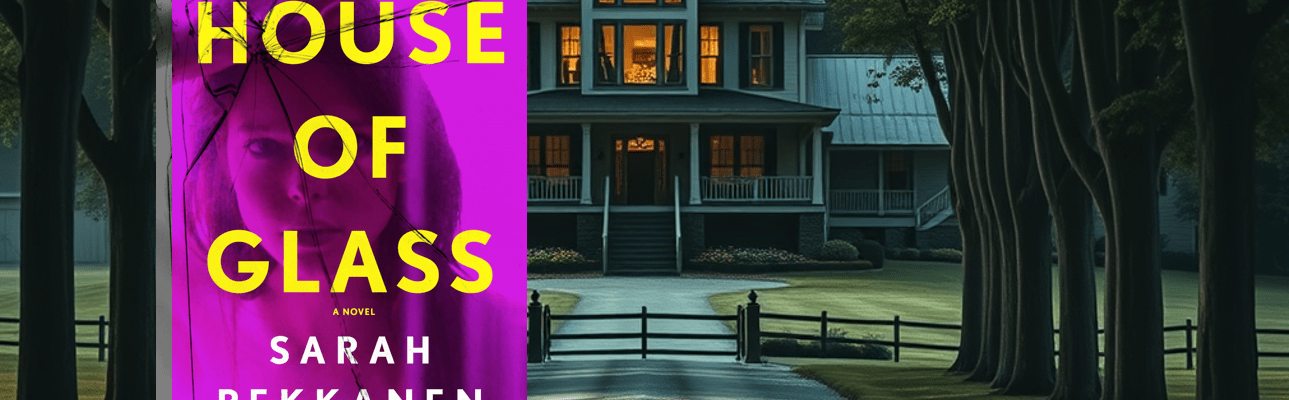

The Stats
Title: House of Glass
Author: Sarah Pekkanen
Publisher: St. Martin’s Press (06 August, 2024)
Genre: General Fiction, Thriller, Mystery Thriller, Psychological Thriller
Trigger Warnings: Violence, Domestic Abuse, Gaslighting and Manipulation, Child engagement, Stalking, Divorce
Read if you like: Local Woman Missing, The Wife Between Us, Bye, Baby, An Honest Lie
Rating: 3.5 out of 5 Stars, rounded up to 4 on Goodreads
Thank you to Sarah Pekkanen, St. Martin’s Press and NetGalley for pre-approving me to receive an electrical Advanced Review Copy of House of Glass.
The Review
I won’t lie: House of Glass didn’t completely hook me at first. The setup was intriguing — a high-profile divorce that takes a sharp turn when the nanny the husband was having an affair with mysteriously falls from a third-story window — but I found myself struggling through the exposition.
Stella Hudson, a Best Interest Attorney (BIA), is appointed as counsel for Rose Barclay, the nine-year-old daughter trapped in the middle of her parents’ divorce. Rose has recently developed traumatic mutism after witnessing her nanny, Tina de la Cruz, fall to her death. This makes Stella’s job even more difficult, especially since Tina’s death has now been deemed a cold case. Between choosing one of Rose’s parents, Ian or Beth, or her grandmother, Harriet, how is Stella supposed to determine who would be the best guardian when the possibility that any one of them could have pushed Tina out the window still lingers? Having experienced traumatic mutism in her own childhood, Stella may be the only one capable of getting Rose to open up and reveal whether Tina’s fall was an unfortunate accident…or an intentional murder. Yet the longer Stella observes Rose, the more it seems the child at the center of it all may be the root of the problem.
It wasn’t until the second half of the book that I really began to turn around. Once the groundwork was laid and the story truly started to unfold, the tension built in a way that finally pulled me in. The first half focused heavily on atmosphere: the strange plastic home, Rose’s silence, and an unsettling sense of overbearing control. It leans into the “demon child” trope so strongly that some moments felt repetitive. Even so, there was something compelling about watching Stella try to decipher this deeply troubled family.
The story takes a noticeable shift in tone as Stella’s own past trauma becomes more central to the plot. Instead of staying tightly focused on the mystery of Tina’s death, the narrative begins digging into Stella’s childhood and the emotional weight she has been carrying for years. While some readers may find this shift disjointed, Stella’s past is actually what drew me deeper into the novel. From the first few chapters, I was convinced the past and present were going to converge, and that anticipation kept me invested.
Where the novel shined for me was the last quarter. The pace picks up, the tension snaps back into place, and the twist finally reframes the story in a satisfying way. Even if the reveal leans a little dramatic, I found the ending rewarding — everything comes together cleanly, questions are answered, and there’s a real sense of closure after so much chaos. What I appreciated most is that the ending leaves room for hope: for Stella, for her future, and for the peace she’s been chasing since childhood. Despite the uneven pacing, the final stretch delivered exactly what I wanted, making House of Glass a reading experience that grew stronger the deeper I went.
Short Review (AKA TLDR)
House of Glass didn’t hook me right away, but once the story settled in, I became increasingly invested. The novel follows Stella Hudson, a Best Interest Attorney assigned to represent Rose Barclay, a nine-year-old who stopped speaking after witnessing her nanny fall to her death. As Stella navigates the tense and unsettling Barclay household, complete with a strange plastic home, controlling family members, and Rose’s eerie silence, the case becomes more complicated. The first half leans heavily into atmospheric setup and “creepy child” tension, but the second half shifts toward exploring Stella’s past in a way that deepened my connection to her. The final quarter delivers the strongest impact: the pace quickens, the twist reframes the story effectively, and the ending ties everything together while still leaving room for hope. Despite uneven pacing, the book ultimately became more compelling the longer I read.
 duffrunstough