

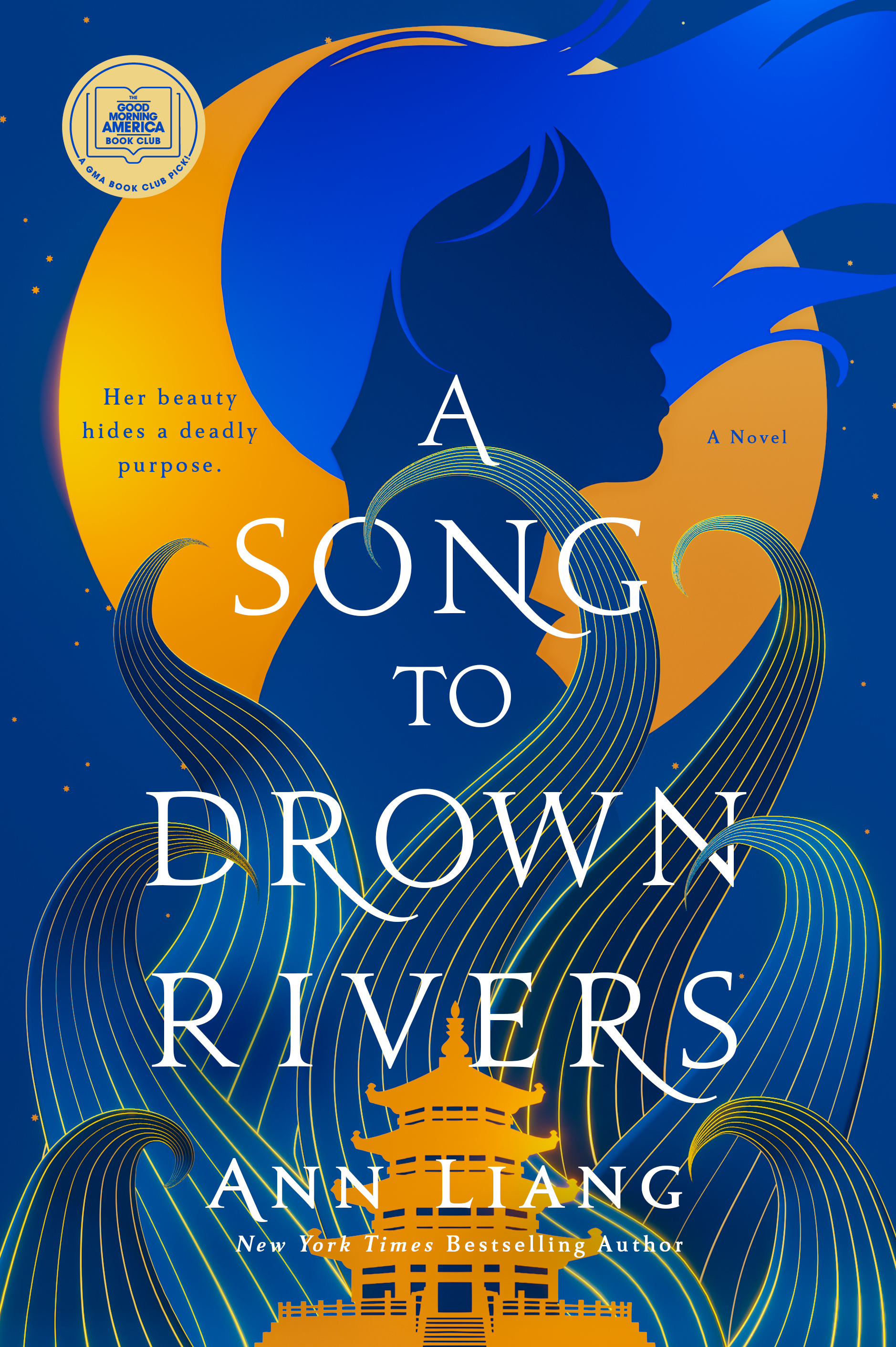
The Stats
Title: A Song to Drown Rivers
Author: Ann Liang
Publisher: St. Martin’s Press (01 October, 2024)
Genre: General Fiction (Young Adult), Fantasy, Romance, Chinese Mythology
Trigger Warnings: War, Death, Blood, Concubines, Self-Harm,
Read if you like: Circe, What the River Knows
Rating: 4.75 out of 5 Stars, rounded up to 5 on Goodreads
Thank you to Ann Laing, St. Martin’s Press and NetGalley for pre-approving me to receive an electrical Advanced Review Copy of A Song to Drown Rivers. Also, a very special thank you to Amelia Beckerman for suggesting I should give A Song to Drown Rivers a shot.
The Review
When I was selected to read A Song to Drown Rivers by Ann Laing, I was not familiar with the original Chinese fables of the Four Great Beauties—the four women known for their immense beauty, one fictional and the others embellished through history. Thus, I had no idea what I was getting myself into. However, I was instantly hooked. This was one story I could not put down; but boy, was this tale harrowing.
In A Song to Drown Rivers, one of the Four Beauties of Ancient China, Xishi, is recruited by the military advisor Fanli to represent her kingdom of Yue as a spy in the rival kingdom of Wu, transforming her breathtaking beauty into a formidable weapon. After an intense training regimen—covering everything from classical music to mastering the art of masking her emotions—Xishi is sent to weaken the kingdom of Wu from within. There, she encounters King Fuchai, a ruler haunted by the shadow of his father. As time goes on, Lady Xishi rises through the ranks of his concubines, ultimately becoming his most trusted confidante. But war is never easy on its women, and Xishi is put to the ultimate test: does she remain loyal to her homeland and Fanli, or does she change course and embrace the home she has now adopted?
I want to start by saying that A Song to Drown Rivers is categorized as a romantic fantasy retelling of the legend of Xishi; however, based on my research, it aligns quite closely with the original story. For those expecting traditional romantasy with elements of fae and magic, this novel does not follow that path. Told in first-person perspective, we experience the story through Xishi’s eyes. She is a compelling protagonist whose complexity is gradually revealed as she navigates the treacherous world of the Wu court. Torn between Fanli and Fuchai, her internal struggles unfold in an unconventional love triangle based on duty.
What truly stood out for me was Laing’s lyrical and immersive writing style, which crafts a hauntingly poetic atmosphere that perfectly encapsulates the splendor and tension of the Wu palace. While the first half of the novel is engaging, the second half proves even more compelling as Laing deepens her exploration of power, sacrifice, and the agency of women in a world meant to control them. She does not shy away from the painful realities of using seduction as a weapon of war, portraying Xishi as more than just a pawn in a political game—she is a strategist, a survivor, and a woman forced to navigate an unforgiving world. Through Xishi’s journey, Laing masterfully highlights the harrowing sacrifices women throughout history have been compelled to make in the name of duty and conflict, reinforcing the novel’s emotional depth and historical significance.
Where the novel faltered for me was in the romance aspect. I did not feel that the connection between Xishi and Fanli was adequately developed before her journey to Wu. It was difficult to believe that Xishi would ultimately choose Fanli over the misunderstood Fuchai, as their relationship—beyond the training sessions—lacked depth. In contrast, Fuchai became increasingly sympathetic with each chapter, showcasing moments of quiet intimacy that made the unfolding tragedy all the more heart-wrenching.
Overall, A Song to Drown Rivers is a powerful retelling that brings Xishi’s story to life with historical accuracy and deep emotion. By focusing on themes of sacrifice, power, and love, the novel questions traditional ideas of heroism and villainy, showing how history is often more complicated than it seems. With its beautiful writing, complex characters, and an unforgettable ending, A Song to Drown Rivers leaves a lasting impact and stands out as a truly remarkable historical novel.
Short Review (AKA TLDR)
When I was selected to read A Song to Drown Rivers by Ann Laing, I was not familiar with the original Chinese fables of the Four Great Beauties. Immediately, I was hooked by this harrowing tale. While categorized as a romantic fantasy, you will not find any fae or magic here. Based on my research the novel is closely aligned with the original account of Xishi’s legend. Told in the first-person perspective, readers experience Xishi’s complex journey in the Wu court, caught between Fanli and Fuchai.
What truly stood out for me was Laing’s lyrical and immersive writing style, which crafts a hauntingly poetic atmosphere. While the first half is engaging, the second half shines brighter. Where the novel faltered for me was in the romance; Xishi’s connection with Fanli feels underdeveloped, making her choice over Fuchai difficult to believe.
Overall, A Song to Drown Rivers masterfully retells Xishi’s story with historical accuracy and deep emotion, exploring themes of sacrifice, power, and love. Its beautiful prose and complex characters create a memorable reading experience.
 duffrunstough
[…] Read if you like: The Bullet Swallower, A Song to Drown Rivers […]
LikeLike